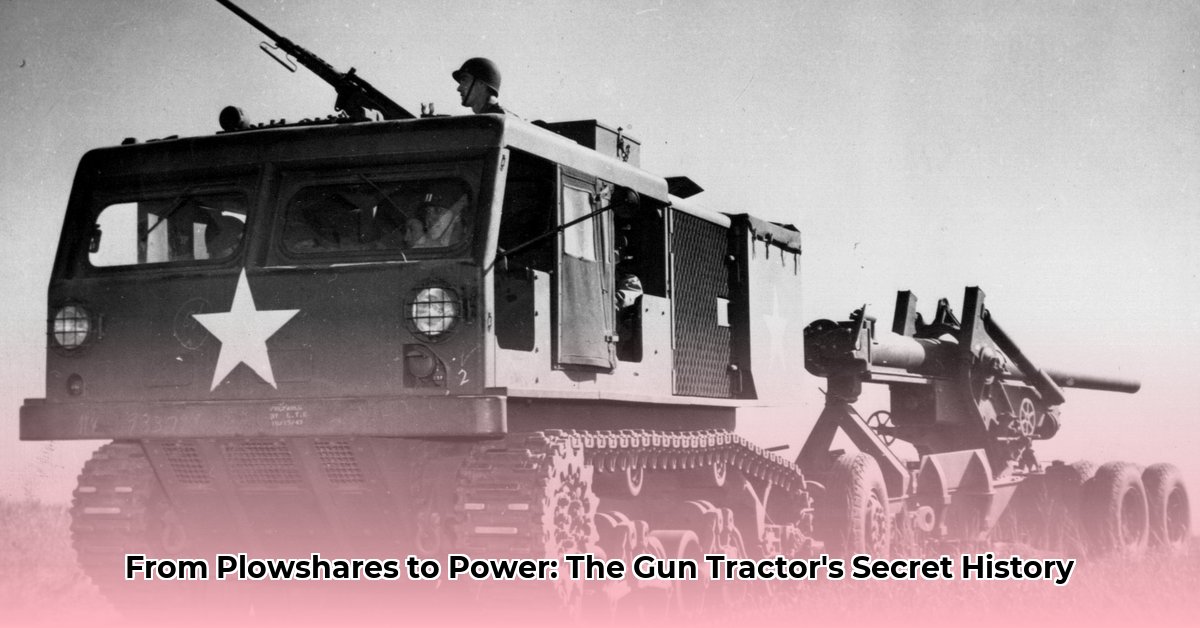
Moving massive artillery pieces across the battlefield has always been a critical logistical challenge. For centuries, the solution was simple: brute strength. Teams of horses, straining under immense weight, hauled cannons into firing positions. These equine powerhouses were the original gun tractors, but their capabilities were severely limited. Muddy terrain easily bogged them down, and long distances resulted in slow, exhausting journeys, hindering rapid deployments. How could commanders ensure their artillery arrived swiftly when needed?
The Dawn of the Motorized Age: Goodbye Horses, Hello Engines!
World War I marked a turning point. The internal combustion engine, no longer a novelty, offered a revolutionary solution. Suddenly, artillery could be moved faster and farther than ever before. These early motorized gun tractors were a diverse group. Some used wheels for speed on roads; others opted for tracks for superior grip on rough terrain. This represented a crucial design trade-off – speed versus ruggedness – a constant consideration for military engineers. This marked the beginning of a technological arms race, with nations vying for the most efficient artillery transport systems. What were the key innovations of this era?
World War II: A Global Gun Tractor Competition
World War II unleashed a torrent of innovative gun tractor designs. Each nation's approach reflected its industrial capabilities and battlefield needs. Mass production became paramount; the demand was staggering. Countries worldwide, including Britain, Canada, and the United States, produced numerous models. The British Morris "Quad," the Canadian Military Pattern (CMP) "Quad," and the AEC Matador, exemplify this period, showcasing diverse engineering solutions to the same core problem: reliable, efficient artillery transport. Some armies even adapted existing trucks into makeshift gun tractors, a cost-effective but limited solution compared to purpose-built designs. Did the strategic context influence design choices?
Self-Propelled Artillery: A New Star Rises
The post-war era witnessed the emergence of self-propelled artillery – cannons integrated onto their own motorized chassis. This innovation largely overshadowed the need for separate gun tractors. The dedicated gun tractor's role diminished, but it didn't disappear entirely. Situations still required separate tractors, especially for exceptionally heavy cannons or challenging terrain where self-propelled units struggled. What factors contributed to the shift towards self-propelled artillery?
Modern Gun Tractors and the Future of Battlefield Logistics
Today, dedicated gun tractors are less prevalent, yet their legacy persists. They've evolved into specialized vehicles for moving the heaviest artillery across the most difficult landscapes. Looking ahead, we can anticipate hybrid or electric gun tractors, reflecting the broader military trend towards eco-friendly, fuel-efficient technology. Experts, such as Dr. Anya Sharma, Professor of Military Logistics at King's College London, predict that some niche applications for dedicated gun tractors will continue to exist. The ongoing need to move heavy weaponry effectively will remain a core aspect of military logistics. Will the dedicated gun tractor eventually disappear altogether?
Gun Tractor Evolution: A Summary
| Era | Primary Power Source | Traction Type | Key Improvements | Challenges |
|---|---|---|---|---|
| Pre-WWI | Horse Power | Wheeled (carts) | Simple, readily available | Slow, limited range, highly susceptible to terrain conditions |
| WWI & Interwar Period | Internal Combustion | Wheeled & Tracked | Increased speed and range, improved terrain handling | Design variations led to logistical complexities |
| WWII | Internal Combustion | Wheeled, Tracked, Half-Tracked | Mass production, specialized designs | Maintaining robust supply chains during global conflict |
| Post-WWII to Present | Internal Combustion, (Future: Hybrid/Electric) | Wheeled & Tracked | Increased efficiency, specialized roles | Reduced relevance due to self-propelled artillery |
The evolution of the gun tractor illustrates not only technological progress but also the changing strategies and logistical demands faced by armies throughout history. From humble horse-drawn carts to potentially electric-powered machines, the gun tractor's story showcases human ingenuity in addressing the enduring need for efficient and effective heavy artillery movement. The journey, however, continues. Ongoing research and development promise further innovations in heavy military equipment transport.
Key Takeaways:
- World War II dramatically accelerated gun tractor evolution, demanding faster, more mobile designs capable of handling increasingly heavier weaponry.
- The war exposed the limitations of existing technologies, spurring innovations in engine power, suspension, and traction.
- Diverse national design philosophies mirrored strategic priorities and resource availability, highlighting the trade-offs between wheeled, tracked, and half-tracked designs.
- Post-war developments reflected lessons learned during the conflict, leading to improvements and ultimately, the rise of self-propelled artillery.
- The M5 High-Speed Tractor exemplified many of these advancements, establishing a benchmark for subsequent artillery towing technology.